
Jump to topic
We are the state’s major industrial water and wastewater service provider.
For decades, we have supported the state’s biggest water consumers in critical industries like power generation, paper mill production, briquette production and food manufacturing.
Our systems were uniquely designed to supply large volumes of water to these historic and current water users. Without these users, the infrastructure becomes underused, but maintenance is still needed.
As the Latrobe Valley economy transitions, the demands on our water supply systems will continue to change significantly.
Recent and future closures of the region’s power stations and other major industries will provide an opportunity for new water-reliant industries to be established, like data centres.
We have the resources, infrastructure and capability to supply raw (untreated) water and wastewater services to these industries.
Our current modelling shows there is enough water within our full existing entitlements to support additional data centre demands, while continuing to manage our existing demands.
To explore our modelling graphs, visit our Interactive Map, select the 'Outlook' tab, then select 'Latrobe'.
With efficient cooling technologies, large data centres may use in the order of 1-2 gigalitres (GL) a year. To put that into context, as the state's major industrial water and wastewater provider, we have supported major customers with demands of up to 30GL a year.
Our highest priority will always be providing drinking water to residential customers.
What water would data centres use?
We are in a position to provide data centres with raw (untreated) water from our bulk entitlements.
Drinking water supply reliability for our residential customers would not be affected.
When assessing new requests for water, we apply the following principles:
- Prioritising town water, industry and environmental obligations
- Only supplying water within our existing entitlements
- Continuing to plan for future growth
How do you know how much water is available?
We undertake modelling and forecasting of our water resources every five years with a 50-year outlook, known as our Urban Water Strategy.
When undertaking the modelling, we consider:
- Level of reliability of drinking water available for residential customers
- Climate change projections
- Growth projections (townships and major industry)
- Industrial requirements and demands
With the decline of existing industry such as coal-fired power generation and paper production, our current modelling shows us there is around 20GL of water available (headway) within the Latrobe system.
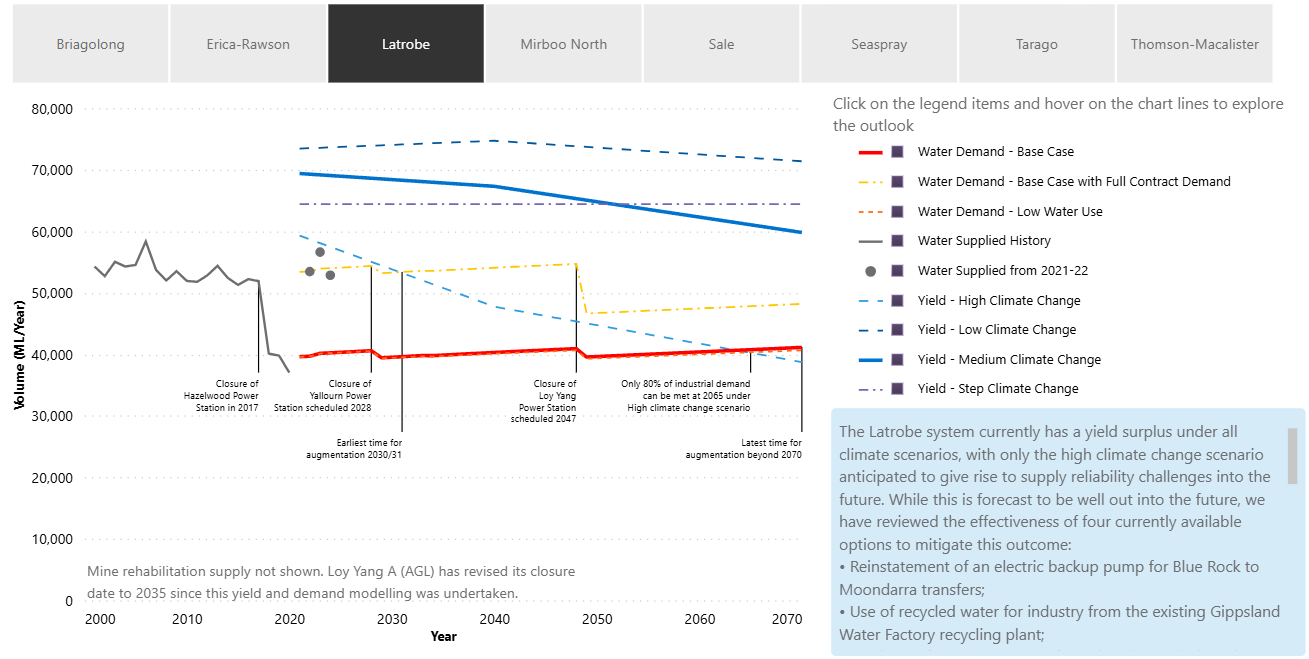
Industry demands are continuing to change. Since the release of our 2022 Urban Water Strategy, one major customer has significantly reduced its water consumption, which will be displayed in future modelling.
Resources in the Latrobe Valley
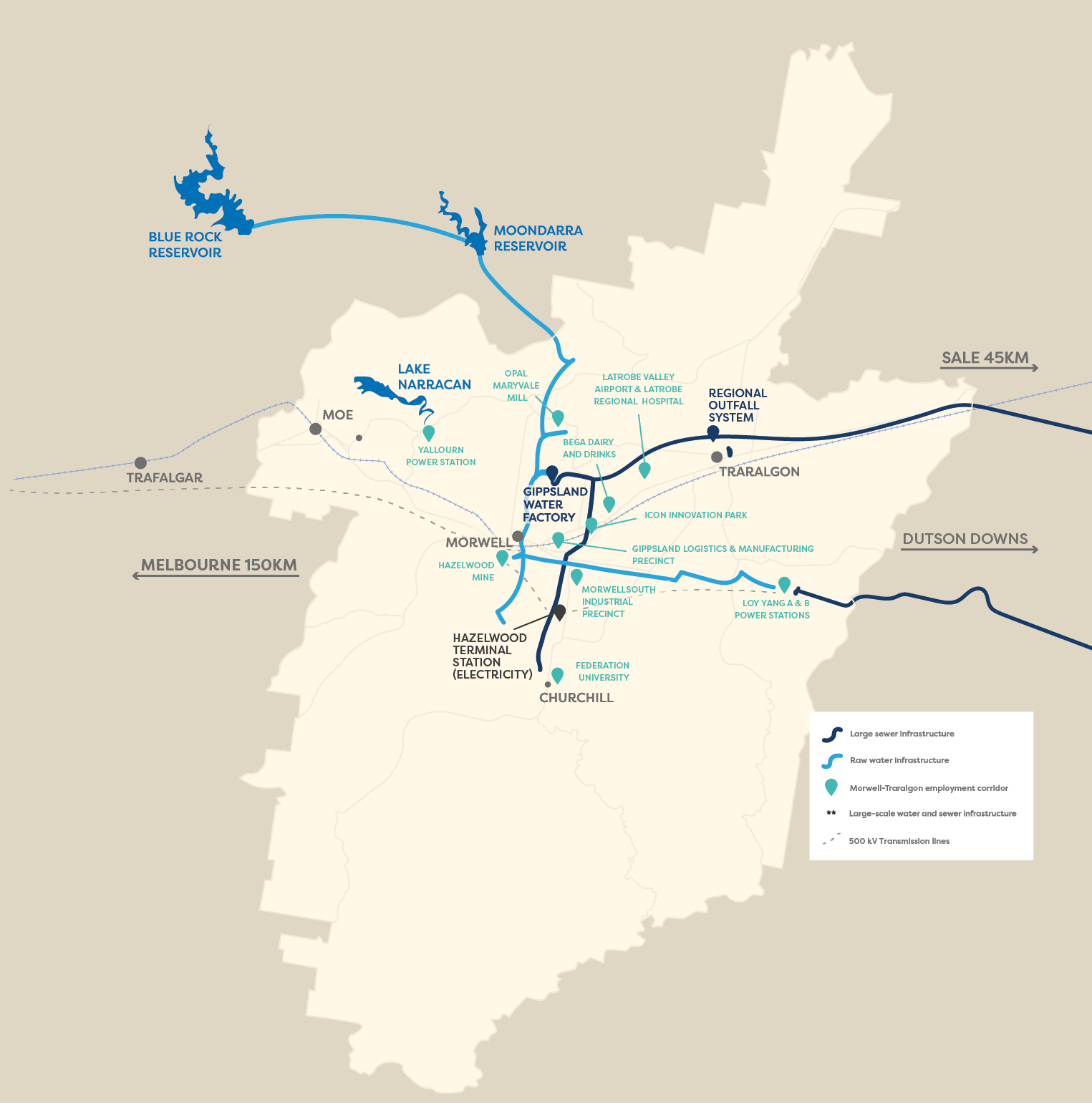
The Latrobe Valley is unique with its significant water resources and established major industry infrastructure for both water supply and waste treatment, co-located with appropriately zoned land and highway access.
Very high reliability power infrastructure (N-3 redundancy and 500kV transmission lines) and the capacity to support hyperscale developments and dark cable communication channels are within close proximity.
More information
About data centres
Data centres are large facilities that store and run computer systems for digital services. Rather than storing data in individual computers, it’s stored in these dedicated buildings.
Data centres house equipment like servers to store and process data, networks to move data, cooling systems to prevent overheating, and backup generators to maintain power supply during potential outages.
Modern digital life revolves around data centres, as they support websites and apps, cloud services, online banking, government and business systems, and artificial intelligence (AI).
Frequently asked questions
New industry brings economic benefits, such as new jobs, to the region.
Our dams and supporting infrastructure in the Latrobe Valley were built and designed for large industry with high reliability, while also supplying residential customers. Having major industrial customers helps share the cost of maintaining and operating this infrastructure.
If these large customers aren’t replaced, a greater share of those costs would fall to residential customers.
Supplying water and wastewater services to data centres would generate additional revenue, helping to avoid rising tariffs, maintaining stable pricing or even potentially put downward pressure on customer bills.
Our current modelling indicates there is enough bulk entitlement and capacity in our system to support potential data centres and future mine rehabilitation.
Different customers have different needs. Power stations, and potentially data centres, are high reliability users, while mine rehabilitation classifies as low reliability usage. This allows us to prioritise water usage during drier periods.
Ensuring there is sufficient town water available for our residential customers will always be our first priority.
We would provide potential data centres with raw (untreated) water from our Latrobe System (Moondarra Dam and our share of the Blue Rock Dam).
This is from our existing and previous major industry customers, as well as for the drinking water supply to residential customers.
Water usage for data centres is dependent on the cooling technology implemented. With efficient cooling technologies, large data centres may use in the order of 1-2 gigalitres (GL) a year.
We already treat wastewater from industrial customers, and we have capacity within our system to accommodate more.
New industries and projects, including data centres, could potentially be accommodated, depending on the location, quality and volume of their waste.
We undertake analysis and review of the demands and requirements for major customers before committing to service provision.
When assessing prospective major customers, we seek to understand:
• Their water demands
• The level of wastewater treatment required, as well as quantity and quality of waste
• The proposed location of the customer
• The proximity of the site to already existing infrastructure
Once this information has been provided and reviewed, a decision to provide services is made.
If further upgrades and/or new infrastructure is needed, it would be funded by the major customer, meaning there would be no adverse impact on residential customer bills.
An appropriate tariff is calculated to cover ongoing costs for provision of service.
This aligns with our User Pays mandate which we engaged with our customers on and implemented as part of our 2023 Price Submission.
The closure of two major customers, Energy Brix (2014) and Hazelwood power station (2017), and the cessation of white paper production at the Australian Paper Maryvale mill have increased our capacity significantly.
Within the next decade, we are set to see the closure of another two power stations, Yallourn (2028) and Loy Yang A (2035). Loy Yang B is also set to close in 2047.
Water entitlements are held by different bodies for different purposes. When discussing water availability, we are referring to the resources we already have available through our existing bulk entitlements. Water used for other purposes like irrigation and the environment are allocated separately and would therefore not be impacted.
We carefully and diligently assess all prospective business enquiries, including data centres, to ensure residential supply and demand remains unaffected. This includes taking various climate scenarios into account.
The Victorian Government has released guidelines for potential large urban water users, such as data centres, that may be seeking to access large volumes of water.
The guidelines can be found on DEECA’s website.